
OURO
Putters engineered around how players see.
Research-driven · Machined · Player-focused
Aiming starts before the stroke.
Aiming starts before the putter moves. Published aim-study literature suggests that misaim of a degree or more at address is common among golfers — context for the problem, not an OURO result. OURO starts with how a player sees, aims, and sets up.
We don’t design putters to look right.
We design around how a player sees, aims, and sets up.
Player-FocusedBegin with the human
Eye dominance, parallax, visual illusions at address — the player's perception is the first engineering constraint, not an afterthought. Every sightline, contour, and contrast decision starts with how a golfer's vision actually works, and will be tested on golfers, not just in CAD.
EngineeredMeasured, not guessed
Aim studies in degrees, acoustic signatures in hertz, tolerances in microns — the intent is for every performance claim we make to be supported by measurement, not asserted from opinion.
CraftedHonor the game
Golf has carried its craft for six centuries — from hand-forged heads to single-setup CNC milling. We hold both ends of that lineage: modern precision manufacturing executed with the patience and finish of the old workshop bench.
Treat aim as a tolerance. Treat feel as a frequency.
We treat perception like any other engineering domain — with numbers. These are some of the measurements our current research and design studies are built on.
Sightlines built to be tested. A screening study of head geometry alone — no sightline present — found that wing forward-sweep angle biases a golfer’s static aim by a measurable margin. Those results now inform 001’s CAD direction and starting geometry, which remains subject to prototype evaluation, design-for-manufacture, sightline testing, and further validation. Next, a controlled aim study of candidate sightline systems on that starting geometry: face angle measured in degrees across real golfers, compared against benchmark putters. Whether the alignment system improves static aim is a planned test question, not a settled result.
Sound as a design variable. Impact sound and post-impact vibration are believed to be major contributors to perceived feel. We plan to measure each prototype’s acoustic signature — spectrum, loudness, decay — with calibrated instrumentation, then shape it through geometry and milling rather than description. The goal: a sound that reflects the strike rather than one tuned to flatter it.
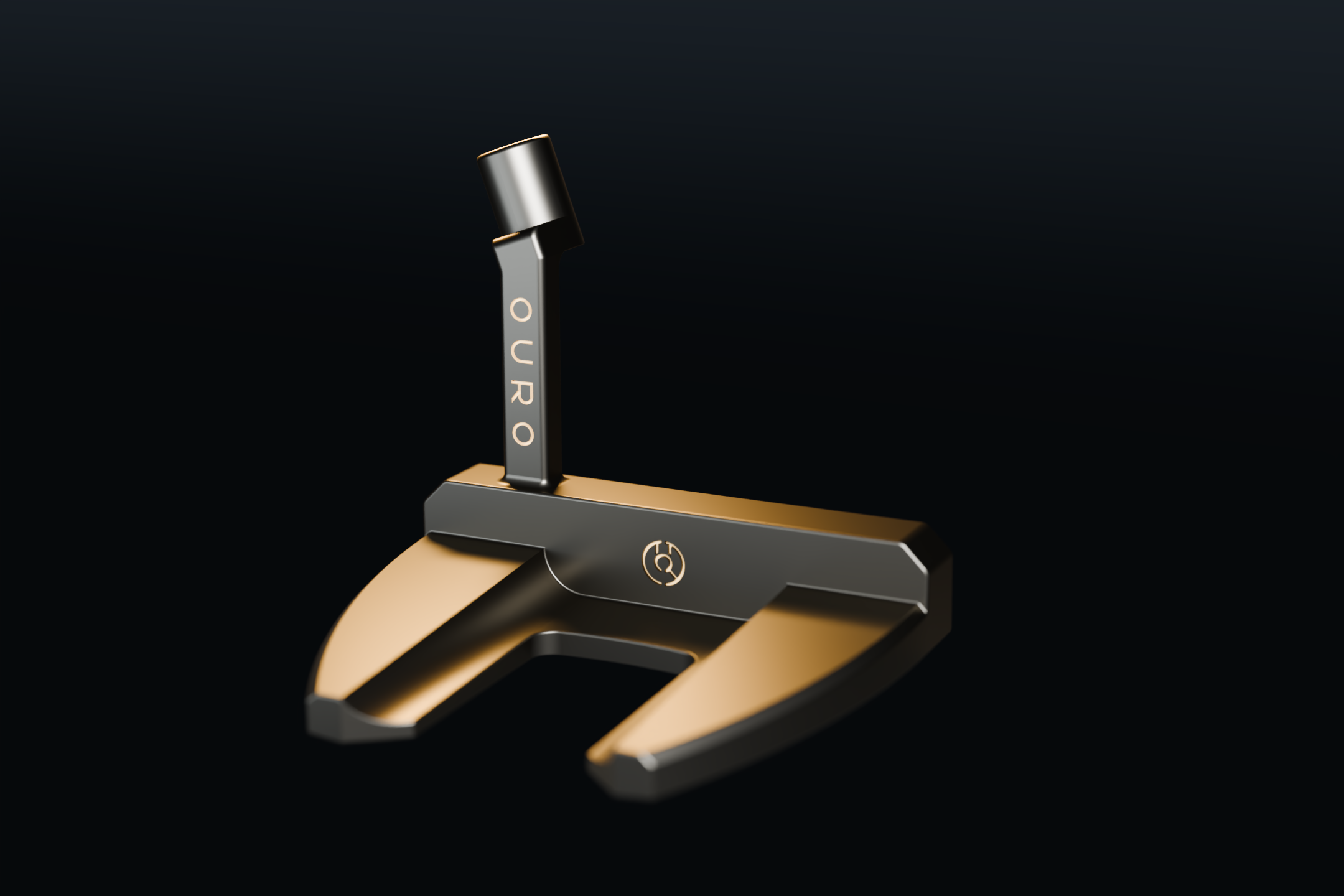
OURO 001
The first revolution of the loop.
A compact mallet built around the player's sightline. The plan is for every alignment feature on 001 to go through a controlled aim study before it ships — face angle measured in degrees, across real golfers, compared against benchmark putters. This page updates as the data arrives.
Studies, machining, failures and all.
Prototype 001 is in the loop.
Follow the engineering journal — studies, machining, failures and all — and be first in line when it’s ready.
No spam. Just the build.